
Capacity
Clever Telecom Capacity is a leased communication channel service delivered at the physical backbone layer using carrier-grade optical transport systems. It offers a direct, dedicated point-to-point connection with guaranteed bandwidth and pre-defined routing behavior, ensuring operational stability for telecom operators, data centers, cloud services, content platforms, infrastructure providers, and multinational enterprises. The service provides channels in their native backbone form, eliminating intermediate protocol or media conversions — enabling minimal latency, deterministic performance, and full control of traffic behavior.
Clever Telecom deploys only carrier-class optical technologies, engineered with DWDM systems, and powered by next-generation multi-lambda transport platforms from optical backbone leaders, focusing on spectral efficiency, high reliability, and global optical reach.
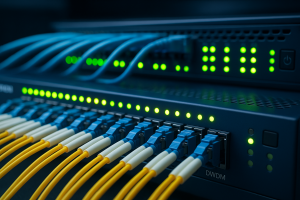
Supported Lambda Speeds (Single-Port / Per Circuit)
✅
| Port/ Circuit Capacity Tier | Support |
|---|---|
| 1 Gbps* | ✅ Select cities, availability may be limited |
| 10 Gbps | ✅ |
| 100 Gbps | ✅ |
| 400 Gbps+ | ⚙️ On request, available on most backbone nodes |
| 800 Gbps | ⚙️ On request |
| 100G – 800G+ | ⚙️ Backbone qualification based deployments |
* 1 Gbps ports may be limited in some cities.** 400 Gbps and higher are supported on most backbone nodes by request.
Path Protection & Resilience Models
| Protection Model | Client Outcome |
|---|---|
| Unprotected Channel | A direct optical path with no backup loop |
| Protected Channel Pair | Automatic optical path protection or a protected channel pair |
| Physically Diverse Routes | Two independent optical paths with zero intersection for highest survivability |
Failure protection behavior is fully automatic for backbone failover if protection model supports it.
Supported Signal Handover Interfaces
| Interface Type | Purpose |
|---|---|
| Ethernet | Standard LAN/WAN transport workloads |
| OTN (Optical Transport Network) | High-throughput transport and backbone adjacency |
| SONET / SDH* | Legacy telecom transport compatibility |
These handover formats ensure support for any transport-class workload, including carrier signaling, corporate data, video transport, cloud exit builds, hybrid PoPs, and storage replication topologies.
Service Delivery Standards
| Standard Class | Support |
|---|---|
| MEF-Aligned Services | ✅ |
| 802.1Q VLAN, QinQ tagging | ✅ |
| Protocol Transparency at L2/L1 | ✅ engineered where applicable |
| Fiber/DWDM Native Handover | ✅ |
Core Client Guarantees
| Domain | Assurance |
|---|---|
| Bandwidth | Guaranteed, uncontended, no contention on the lambda |
| Routing Path | Fixed, backbone-native optical behavior |
| Monitoring | 24/7 network monitoring + L1 optical diagnostics |
| Activation Speed | 5 business days where optical path readiness allows |
| Reliability Gear | DWDM equipment from global optical backbone leaders |
SLA & Commercial Commitments
| SLA Parameter | Value |
|---|---|
| Standard Availability SLA | Up to 99.95% uptime |
| Maximum SLA Ceiling | 99.95% depending on location and protection model |
| Promoter Tier Availability | 99.95%+ available by qualification |
| Diagnostic SLA | L1 optical fault domain diagnostics |
| Contract Flexibility | Short-term or long-term, customized billing and settlement |
Use Case Fit
| Segment | Typical Deployment |
|---|---|
| Carriers & Telecom Operators | Optical bandwidth leasing, signaling, backbone breakouts |
| Data Centers | Lambda exits, transport adjacency |
| Cloud Providers | IP/MPLS peering exits via optical |
| Enterprises | International LAN/VPN transport and deterministic Internet exits |
| Content Platforms | Video and media optical transport |